
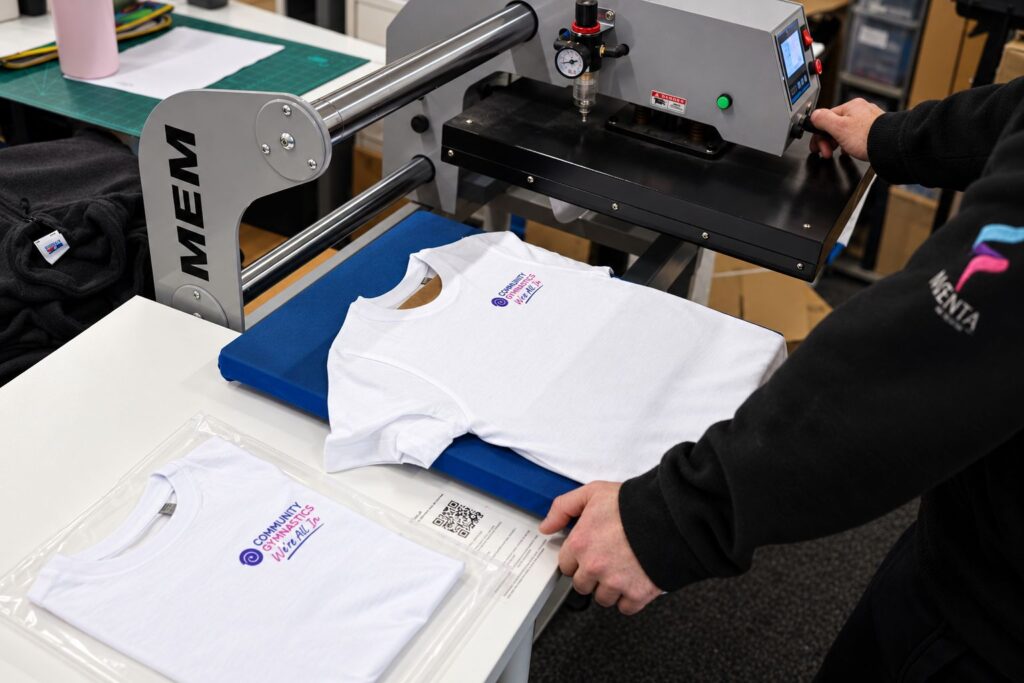
For years, screen printing has been the standard for custom printed clothing. Direct-to-Film (DTF) printing now gives businesses a faster, more flexible and cost-effective way to produce high-quality branded garments, especially for smaller orders and print-on-demand.
At The Branding Works we’ve invested in modern garment decoration so our customers get the best of both worlds: high-quality DTF printing alongside our established embroidery operation of 10 embroidery machines. Here’s why we think DTF is so well suited to today’s custom clothing market.
The short version
- Under 100 garments, or full-colour artwork? DTF is usually the better choice. No screens, no set-up per colour.
- Hundreds of the same simple design? Screen printing can still work out cheaper.
- Want a premium finish on polos, jackets or caps? Embroidery. We have 10 machines in-house.
What is DTF printing?
Direct-to-Film printing is a modern decoration process. The design is printed onto a specialist film using textile inks, then an adhesive powder is applied and cured. Finally, the design is transferred onto the garment with a professional heat press.
Unlike screen printing, DTF doesn’t need a separate screen preparing for each colour. That makes it ideal for detailed artwork, intricate logos, full-colour graphics and smaller runs, and it works on a wide range of fabrics, including cotton, polyester and many blends.
DTF vs screen printing at a glance
| DTF printing | Screen printing | |
|---|---|---|
| Small orders | Excellent | Often less economical |
| Orders under 100 | Usually cost-effective | Depends on design and colours |
| Large bulk orders | Suitable | Often more economical |
| Full-colour designs | Excellent | Can need specialist techniques |
| Set-up costs | Minimal per design | Screens required |
| Individual personalisation | Excellent | Less practical |
| Print-on-demand | Ideal | Generally less suitable |
| Print feel | Thin, flexible transfer on the fabric surface | Ink sits in the fabric; very soft on simple designs |
Screen printing is still a fantastic process for large quantities of identical designs. Once the screens are made, printing hundreds or thousands of garments is very efficient. For smaller quantities, multiple designs and frequently changing orders, DTF has some big advantages.
Why DTF is ideal for orders under 100
The biggest hurdle with screen printing is set-up. Each colour can need its own screen, and the time spent preparing them makes small orders disproportionately expensive. DTF removes most of that preparation, so whether you need 10, 25, 50 or 100 printed T-shirts, we can produce professional results without the traditional set-up.
For you, that means:
- More economical production for smaller quantities
- Full-colour artwork without a screen for every colour
- Freedom to order several different designs
- Faster turnaround with less preparation
- Easy to reorder small quantities when you need them
Why DTF works so well for print-on-demand
Rather than buying hundreds of garments upfront, businesses, sports clubs and organisations can sell branded clothing through an online store and have each item made as orders arrive. Our print-on-demand service is built around exactly that, and DTF lets us produce each design efficiently without setting up a screen printing job every time an order comes in.
It’s particularly useful for:
- Sports clubs and teams selling kit and merchandise to members
- Clothing brands testing new designs without committing to big quantities
- Businesses kitting out new and existing staff
- Schools and organisations offering merchandise all year round
- Events and promotional campaigns that need shorter runs
Instead of ordering stock and hoping it sells, you only pay for what’s ordered. That means less money tied up in stock, no overproduction and the freedom to offer a much wider range.
DTF and embroidery under one roof
DTF is fantastic for printed designs, but embroidery still has an essential place in professional branded clothing. It gives a premium, textured finish that’s especially popular on workwear, polo shirts, sweatshirts, jackets and caps. With 10 embroidery machines alongside our printing equipment, we have substantial in-house capacity, and the combination is one of our biggest strengths.
For example, one business order might include:
- Embroidered logos on staff polo shirts
- Full-colour DTF prints on promotional T-shirts
- Embroidered branding on jackets and fleeces
- Printed designs on hoodies and sweatshirts
- Staff names or other personalisation
You get all of it from one production partner, and we choose the best decoration method for each garment rather than forcing every design through the same process. For print-on-demand stores, that means different products in the same collection can be printed or embroidered depending on the finish you want.
Does DTF replace screen printing?
Not entirely, and we don’t think it should. Screen printing is still an excellent choice for large runs of identical designs with only a few colours. An order of 1,000 T-shirts with a simple one-colour logo, for example, may well be cheaper screen printed.
The economics change when you’re producing 20, 50 or 75 garments, especially with multi-colour or detailed artwork. That’s where DTF really comes into its own. As with any process, the quality of the materials, the application and garment care all play their part in the finished result.
A more flexible approach to custom clothing
Not every customer needs hundreds of garments at once. Sometimes a business needs 15 new uniforms, a sports club needs five more hoodies, or a clothing brand wants to test a design before a bigger run. By combining DTF printing with our 10 embroidery machines, we can handle everything from small one-off orders to ongoing uniform programmes and online print-on-demand stores.
Not sure which method suits your order?
Send us your logo and roughly how many garments you need. We’ll recommend print or embroidery and send a free proof before anything goes into production.